Port of Busan: Japan–Korea Services, Transshipment, B/L and Cargo Claims Practice
 Interlink編集部
Port of Busan: Japan–Korea Services, Transshipment, B/L and Cargo Claims Practice
The Port of Busan is South Korea’s largest-scale international port and one of East Asia’s principal transshipment hubs. It handles not only Korean import and export cargo but also cargo moving between Japan, China, Southeast Asia, North America and Europe.
For Japan-bound cargo, routing through Busan can provide feeder connections, additional sailing frequency and access to ports with limited direct services. However, transshipment adds discharge from the first vessel, temporary yard storage, possible inter-terminal transportation, loading onto the connecting vessel and, for LCL cargo, possible re-consolidation. These additional stages make cargo custody, B/L responsibility, evidence and delay management more complex than under direct carriage.
It is not sufficient to confirm only that cargo has arrived at Busan. The freight forwarder must separately confirm discharge from the first vessel, the terminal where the cargo is located, the terminal used by the connecting vessel, actual loading onto the connecting vessel and the connecting vessel’s departure.
Scope of This Article
| Item | Covered in This Article | Covered Elsewhere |
|---|---|---|
| Role of the Port of Busan | Its function as South Korea’s principal import-export port and an East Asian transshipment hub | Annual throughput, current berth numbers and terminal statistics should be checked against information published by the Busan Port Authority |
| Japan-bound transportation | Differences among direct services, same-terminal transshipment, inter-terminal transshipment, LCL re-consolidation and ferry services | Customs clearance, warehouse release and domestic delivery after arrival in Japan are covered in the import domestic delivery claims series |
| Connection delay | Procedures for confirming cargo movement from arrival of the first vessel through loading onto the connecting vessel | Detailed interpretation of tracking events and cargo remaining at a hub port is covered in Cargo Stuck at a Transshipment Port |
| B/L | Reconciliation of the Port of Loading, Port of Discharge, Place of Receipt, Place of Delivery, vessel details and actual routing | Transfer, endorsement, cargo delivery and loss of a B/L are covered in the relevant B/L articles |
| Marine cargo insurance | Ordinary transshipment, physical damage, delay, change of voyage and temporary storage | Detailed application of the insurance period, deviation clauses and individual policy clauses is covered in the marine cargo insurance articles |
| Evidence of cargo damage | Terminal records, EIRs, photographs, temperature records, handling records and loading timestamps | Insurance claim documentation and survey procedures are covered in the cargo claims articles |
| Rules of origin | Potential effects of transshipment at Busan on proof of direct consignment or direct transport | EPA and FTA direct transport requirements are covered in the Direct Consignment Rule article |
| Letters of credit | The need to reconcile actual transshipment with transport document requirements | Transshipment prohibitions and bank document examination are covered in the letter of credit and discrepancy articles |
| Passenger procedures | The logistics significance of the Busan–Shimonoseki ferry service | Passport, visa, immigration and passenger booking procedures are outside the scope of this article |
History and Port Structure
The Port of Busan opened as a modern international port in 1876 and subsequently expanded in line with South Korea’s industrial development and growth in international trade. The modern Port of Busan does not refer to one berth or one container terminal.
For operational purposes, it must be understood as a group of port areas and terminals, including Busan New Port, which handles a substantial share of container operations, Busan North Port near the urban area and other facilities handling general cargo and specialized operations. A B/L or tracking display showing only “BUSAN” or a port code may not identify the terminal where the cargo is physically located.
Where the first vessel and connecting vessel use the same terminal, the container may be transferred within that terminal’s yard. Where they use different terminals, the container may need to be gated out and moved by road or another approved method to the connecting terminal. This distinction directly affects connection time, additional cost, the possible location of an accident and the availability of evidence.
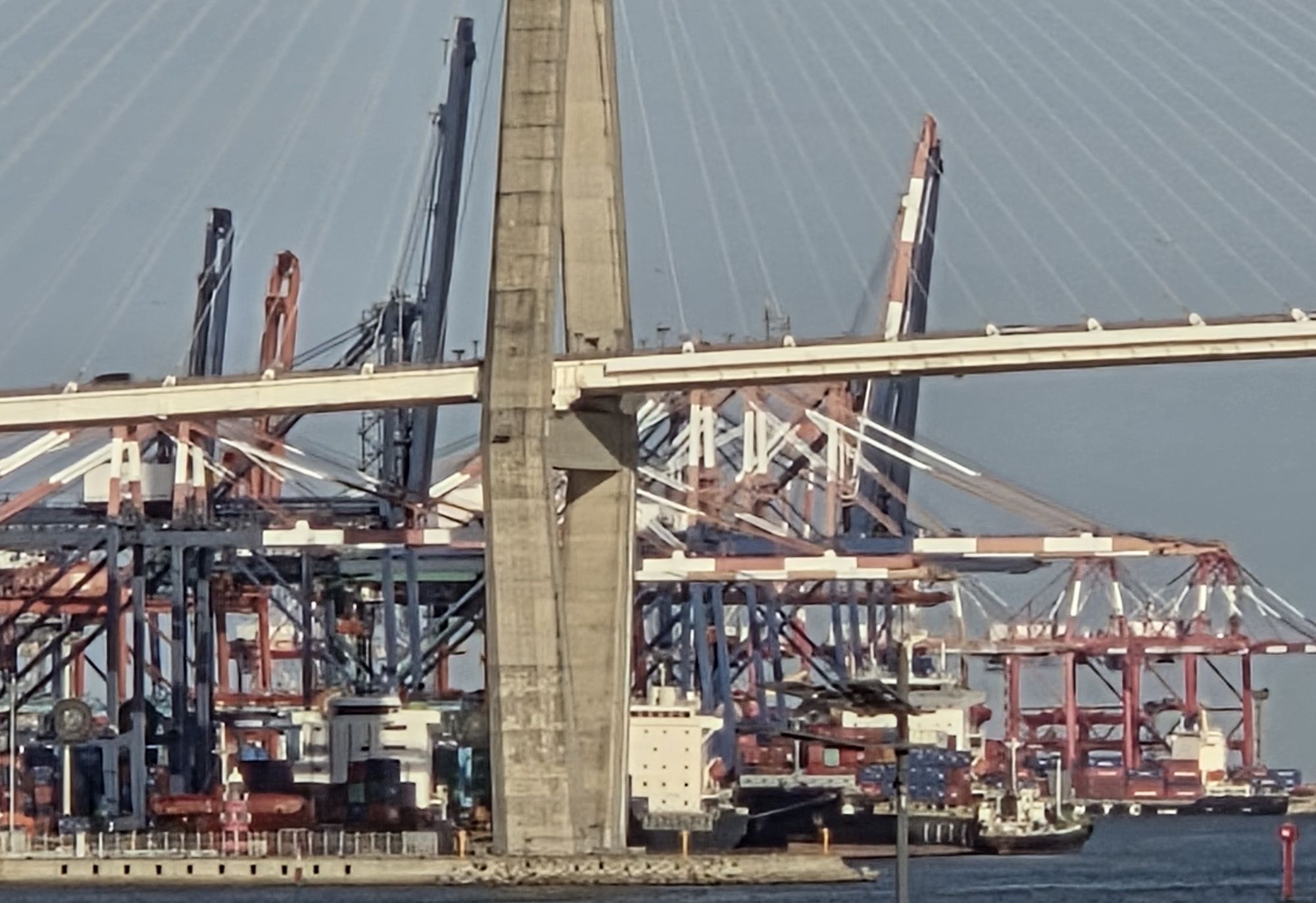
Principal Transportation Patterns for Japan-Bound Cargo
| Transportation Pattern | Cargo Movement at Busan | Principal Risks | Key Records | Lead-Time Assessment |
|---|---|---|---|---|
| Direct service to a Japanese port | The cargo moves from the loading port to Japan without transshipment at Busan | Cancellation, port rotation changes and vessel delay | Booking Confirmation, shipping line schedule and B/L | Focus on the vessel’s actual departure and revised port rotation |
| Same-terminal transshipment | The container is discharged from the first vessel and loaded onto the connecting vessel within the same terminal | Insufficient connection time, rollover and yard accident | Discharge record, yard location, load confirmation and connecting vessel details | Use actual loading onto the connecting vessel rather than arrival of the first vessel |
| Inter-terminal transshipment | The container is moved from the first vessel’s terminal to the connecting vessel’s terminal | Gate procedures, vehicle availability, congestion, cut-off failure and road accident | Terminal names, EIRs, gate records, vehicle records and connection cut-off | Include sufficient time for inter-terminal transportation |
| LCL re-consolidation | The cargo may be devanned, sorted or re-consolidated at a CFS before onward carriage | Shortage, mis-sorting, package damage and loss of labels | CFS tally, receipt and release records, House B/L and packing photographs | Trace individual packages rather than relying only on container-level events |
| Refrigerated container | Power supply and temperature control must continue during yard storage | Power interruption, incorrect set point, connection delay and temperature excursion | Reefer log, set point, plug-in record and alarm history | Assess temperature history and cargo tolerance, not only the number of delayed days |
| Dangerous goods | Acceptance by the connecting shipping line and terminal is required before onward loading | Declaration error, stowage restriction, storage limit and rollover | Dangerous goods declaration, approval reference, SDS and connecting vessel acceptance | Do not rely on the ordinary cargo schedule without confirming dangerous goods approval |
| Ferry or RO-RO transportation | Passengers, vehicles and cargo move on a short-sea service | Acceptance cut-off, vehicle conditions, cargo restrictions and cancellation | Ferry booking conditions, cargo details and vehicle information | Apply the service-specific cut-off and handling conditions |
Transshipment Confirmation Flow at Busan
- Confirm the routing at booking. Identify the first vessel, Busan call, connecting vessel and final Japanese port. Explain that the routing is provisional and may later change.
- Confirm actual departure of the first vessel. Use the actual departure time, vessel name and voyage number rather than the original schedule.
- Confirm discharge at Busan. A vessel’s arrival at Busan is not the same as discharge of the container. Confirm a Discharged event or terminal receipt.
- Identify both terminals. Determine whether the first vessel and connecting vessel use the same terminal or whether inter-terminal transportation is required.
- Confirm acceptance by the connecting service. Check the revised vessel, cut-off, dangerous goods approval, refrigerated cargo acceptance and documentation deadline.
- Confirm loading onto the connecting vessel. A connecting vessel name appearing in the system does not prove that the cargo has been loaded. Confirm an actual Loaded on Vessel event or equivalent record.
- Confirm actual departure of the connecting vessel. Loading alone does not mean that the cargo has begun the voyage to Japan.
- Update arrangements in Japan. Revise the Arrival Notice, customs plan, warehouse receiving slot and delivery reservation according to the actual connection.
The essential point is to treat arrival at Busan, discharge, assignment to a connecting vessel, loading and departure as separate events. Describing all of these stages to the cargo owner merely as “on schedule” can create an explanation and liability issue if a rollover is later discovered.
Separating B/L Particulars from the Actual Routing
The Port of Loading, Port of Discharge, Place of Receipt and Place of Delivery are important fields describing the contractual places and scope of carriage. However, those fields do not necessarily show every intermediate port or the actual terminal used during transshipment.
Where a Through B/L is issued from the loading point to the final Japanese port, the Japanese port may appear as the Port of Discharge while Busan does not appear in the principal B/L fields. The absence of Busan from the B/L must therefore not be treated as proof of direct carriage.
Conversely, a liberty or transshipment clause in a B/L authorizes the carrier to transship under the contract. It is not evidence that transshipment actually occurred at Busan. Actual routing must be established by reconciling the Booking Confirmation, shipping line or freight forwarder tracking, Ocean B/L, House B/L, Arrival Notice and terminal records.
Where both a House B/L and Ocean B/L exist, the contractual scope under the House B/L may not be identical to the shipping line’s contractual scope under the Ocean B/L. From the cargo owner’s perspective, the initial contractual inquiry should normally begin with the Contracting Carrier or House B/L issuer that issued the relevant transport document.
Freight Forwarder Involvement and Contractual Status
The terminal performing the physical handling, the shipping line operating the connecting vessel and the freight forwarder arranging the shipment are separate parties. Following damage or delay, the party performing the operation and the party contractually responsible to the cargo owner must be identified separately.
These five classifications are not legal classifications established by law or across the industry. They are an analytical framework used by Maritime Wiki to organize the contractual and operational scope of a freight forwarder's involvement.
| Standard Five Classifications | Typical Involvement | Responsibility to Examine for Busan Routing | Principal Counterparty | Key Caution |
|---|---|---|---|---|
| 1. Simple Intermediary | Limited to introducing a rate or arranging a booking | Whether operational information received from the carrier was accurately communicated | The carrier that actually undertook the transportation | Acting as a communication channel does not by itself make the intermediary the Contracting Carrier |
| 2. Cargo Transportation Service Provider | Arranges ocean carriage, inland transportation or multiple transportation stages | The accepted stages, subcontractor selection and scope of connection management | Contractual counterparty, subcontracted carrier and shipping line | Do not confuse the operator’s regulatory status with its responsibility under the individual contract |
| 3. NVOCC / House B/L Issuer | Issues a House B/L in its own name and undertakes carriage for the cargo owner | Contractual responsibility for through carriage, transshipment, subcontracted carriers and delivery | The House B/L issuer | It may be the cargo owner’s initial claim recipient even where the Actual Carrier or terminal caused the event |
| 4. Door-to-Door Single Contractor | Undertakes transportation from collection through final delivery | Coordination of the entire operation, including connection at Busan and alternative arrangements after disruption | The freight forwarder that entered into the single contract | The use of multiple subcontractors does not automatically divide its responsibility to the cargo owner |
| 5. Agent / Coordinator for Specific Operations | Performs limited duties under instructions from a shipping line, cargo owner or overseas agent | The scope of delegated notification, documentation, terminal coordination or casualty reporting duties | The principal that issued the instructions | It must not enter into transportation obligations or admit liability beyond its authority |
In addition to the Standard Five Classifications, determine whether the freight forwarder acts as a Contracting Carrier, Actual Carrier, agent or intermediary. Separately identify the operations actually delegated to it, including booking, B/L issuance, dangerous goods declaration, insurance arrangement, inter-terminal transportation, casualty notification and recourse handling.
Operations such as terminal handling, storage, inspection, stowage, vanning, devanning or inter-terminal transportation do not replace these five classifications and do not constitute a sixth classification. The party performing the physical operation and the party contractually responsible to the cargo owner must be identified separately.
Physical Damage, Delay and Change of Voyage under Marine Cargo Insurance
Ordinary transshipment at Busan does not automatically terminate marine cargo insurance where it forms part of the scheduled transportation or the ordinary course of transit. Actual cover depends on the insurance policy, applicable Institute Cargo Clauses, endorsements, declared transit and duration of insurance.
The first distinction is whether the cargo has sustained physical loss or damage or whether it has merely arrived late. Lost sales, factory interruption or contractual penalties caused by a missed connection are economic losses distinct from physical damage to the insured cargo.
Under the Institute Cargo Clauses, loss, damage or expense caused by delay is generally excluded even where the delay results from an insured risk. A connecting vessel delay at Busan therefore does not by itself establish a recoverable marine cargo insurance claim.
Where the cargo itself is damaged by dropping, impact, container damage, rainwater or seawater ingress, or a temperature excursion in a refrigerated container, cover may be available subject to the cause, insured conditions and applicable exclusions.
Unexpected long-term storage, interruption of transit, change of destination or departure from the ordinary course of transit may affect continuation of cover. The insurer or insurance agent should be notified promptly so that continuation of cover, amended conditions or additional premium can be considered.
Cases Commonly Problematic in Practice
| Case | Principal Causes | Records to Check | Decision Point | Initial Response |
|---|---|---|---|---|
| Rollover from the connecting vessel | Delay of the first vessel, insufficient connection time, lack of space or operational change | First vessel events, connecting cut-off, load record and rollover notice | Whether cargo reached the terminal before or after the connecting cut-off | Confirm the next sailing, alternative port, additional cost and effect on Japanese arrangements |
| Cargo remains between different terminals | Incorrect terminal information, lack of vehicles, gate procedures or congestion | Both terminal names, EIRs, gate records and vehicle dispatch records | Which party was contractually responsible for arranging inter-terminal transportation | Establish the present location, arranging party, connection cut-off and provisional cost allocation |
| Container dent or wet damage | Handling impact, contact between containers, door or roof damage and water ingress | Discharge EIR, gate EIR, photographs, survey and weather or handling records | The first handover point at which external damage was recorded | Record a reservation, notify the carrier, preserve photographs and arrange a survey |
| Temperature excursion in refrigerated cargo | Power interruption, incorrect set point, equipment failure, door opening or prolonged storage | Reefer log, plug-in record, alarms, set-point instruction and cargo temperature | Whether the matter is delay alone or physical deterioration caused by temperature change | Preserve temperature data, inspect the cargo and notify the insurer |
| Shortage or package damage in LCL cargo | CFS mis-sorting, re-consolidation, loss of labels or handling damage | CFS tally, receipt and release records, devanning record, packing photographs and House B/L | Whether package-level custody records form a continuous chain | Notify the CFS and House B/L issuer and request a search for remaining cargo |
| Rejection of dangerous goods by the connecting service | Incorrect declaration, missing SDS, non-compliance with shipping line conditions or stowage restriction | Dangerous goods declaration, SDS, approval email, booking conditions and stowage information | Whether the cause lies in cargo owner information, the freight forwarder’s declaration or a change by the connecting carrier | Prioritize safety, correct the declaration and confirm storage and next-vessel acceptance |
| Actual routing differs from the B/L particulars | Operational change, connecting vessel change or inconsistency between House B/L and Ocean B/L | Both B/Ls, Booking Confirmation, tracking history and Arrival Notice | Whether the change was contractually permitted and whether it affects an L/C or insurance declaration | Make required corrections or notifications to the cargo owner, bank, insurer and carriers |
| Additional costs are claimed as consequences of Busan delay | Cancelled warehouse slot, waiting vehicle, rebooking or special storage | Quotation terms, contractual conditions, reservation records, invoices and delay records | Actual expenditure, causation, foreseeability and the contractually responsible party | Separate each cost item and avoid a blanket admission of liability |
Evidence Used to Identify the Period of Damage
The place where damage is discovered is not necessarily the place where it occurred. Wet damage found after arrival in Japan may have resulted from the first sea leg, discharge at Busan, yard storage, inter-terminal transportation or the connecting sea leg.
The analysis should place each custody event in chronological order. Relevant records include discharge from the first vessel, terminal receipt EIR, gate-out and gate-in events, loading onto the connecting vessel, discharge in Japan and final delivery receipt. The first recorded abnormal condition helps narrow the relevant period.
Photographs should retain the date and place of capture and show the container number, seal number, damaged area and cargo position. For refrigerated cargo, the container temperature record should be reconciled with the set-point instruction, power connection history, cargo core temperature and inspection findings.
Contractual analysis must identify the Contracting Carrier, Actual Carrier, terminal operator, inter-terminal carrier and House B/L issuer. The party that physically caused the damage and the party contractually answerable to the cargo owner are not necessarily the same.
Example 1: Wet Damage to FCL Machinery Routed from Shanghai through Busan
Assume that machinery valued at approximately JPY 12 million is shipped from the Port of Shanghai through Busan to the Port of Hakata and wet damage of approximately JPY 2.4 million is discovered during devanning in Japan. The container roof shows visible deformation.
Photographs taken in Japan do not by themselves prove that the accident occurred at Busan. The investigation should compare the EIR at discharge from the first vessel, Busan gate records, loading record for the connecting vessel, the Japanese discharge EIR and relevant weather records.
If the Busan receipt EIR records no abnormality but the Japanese discharge EIR first records roof deformation, the period from loading at Busan through discharge in Japan becomes the principal investigation period. However, an EIR may omit existing damage, so terminal photographs and survey findings should also be examined.
The initial contractual claim and response should begin with the House B/L issuer or Contracting Carrier that undertook the through carriage. Any subsequent recourse against the Actual Carrier or terminal should be handled separately.
Example 2: Refrigerated Food from Hamburg Rolled Over at Busan
Assume that refrigerated food valued at JPY 8 million is shipped from the Port of Hamburg through Busan to the Port of Yokohama and remains at Busan for four additional days following a connecting vessel change. The Japanese buyer claims lost sales and a contractual penalty of JPY 600,000.
The first issue is whether the food sustained a temperature excursion, quality deterioration or other physical damage. If the reefer log, power connection history and inspection results are normal, the matter primarily concerns economic loss caused by delay rather than physical damage to the cargo.
Under marine cargo insurance, lost sales and contractual penalties caused by delay are generally distinguished from physical cargo damage and are likely to fall within the delay exclusion. A contractual claim against the carrier requires separate analysis of the reason for the vessel change, the carrier’s liberty clauses, whether an arrival date was guaranteed, foreseeability of the penalty and any limitation of liability.
A loss being excluded from insurance does not establish that the carrier has no contractual responsibility. Conversely, a missed connection does not automatically establish carrier liability. Insurance and transportation liability must be analyzed separately.
Example 3: LCL Shortage after CFS Handling on a Port Klang–Busan–Kobe Route
Assume that 120 packages of LCL cargo are shipped from Port Klang through Busan to the Port of Kobe and eight packages valued at approximately JPY 450,000 are missing when the cargo is received at the Japanese CFS. Unlike FCL cargo, LCL cargo may be devanned, sorted and re-consolidated at an intermediate CFS.
An intact container seal does not prove that no package shortage occurred. The investigation should examine the Busan CFS devanning record, cargo tally, re-consolidation record, label information and receiving record at the Japanese CFS.
If the Busan CFS recorded receipt of all 120 packages but only 112 packages were loaded into the connecting container, the initial investigation should focus on remaining cargo, misrouting or mis-sorting. If only 112 packages were received at the Busan CFS, the earlier leg must also be investigated.
The House B/L issuer may be the initial contractual contact for the cargo owner. It should not simply direct the cargo owner to negotiate with the CFS based only on the possibility that the CFS caused the shortage. The House B/L issuer’s own contractual status must first be established.
Busan–Shimonoseki Ferry and Short-Sea Logistics
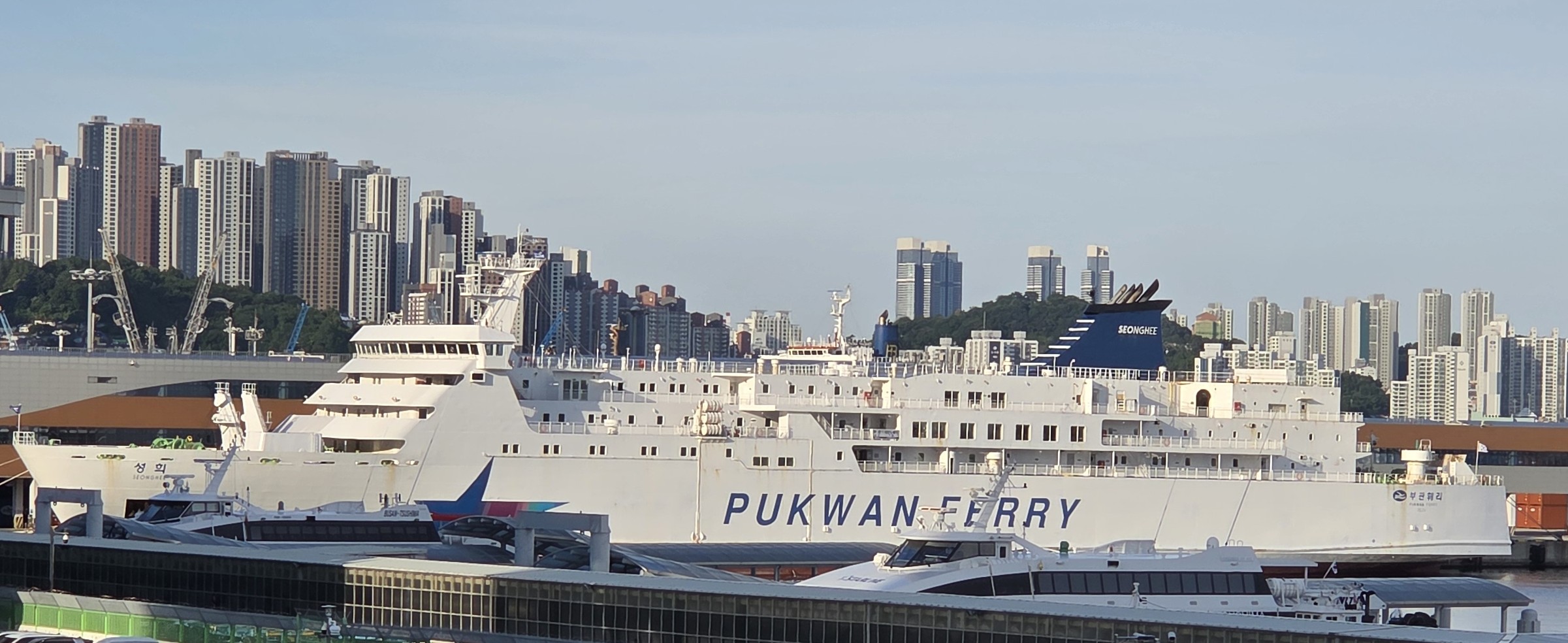
The Port of Busan is not only a transshipment hub for large container vessels. It is also a base for short-sea transportation between South Korea and Japan, including the ferry service connecting Busan and Shimonoseki. Ferry and RO-RO transportation may be subject to cargo acceptance, vehicle, delivery cut-off and handling requirements that differ from conventional container services.
The relatively short sailing distance can make a ferry service suitable for urgent or lead-time-sensitive cargo. The comparison must nevertheless include cargo acceptance, dangerous goods restrictions, vehicle or chassis arrangements, customs timing and alternative routing in the event of cancellation.
Common Misconceptions
| Misconception | Actual Position | Operational Caution |
|---|---|---|
| If Busan is not stated on the B/L, the service must be direct | An intermediate transshipment port may not appear in the principal fields of a Through B/L | Reconcile the booking, tracking and Ocean B/L |
| Arrival at Busan means the cargo has connected to the Japan-bound vessel | Arrival, discharge, terminal receipt, loading and departure are separate events | Confirm Loaded on Vessel and actual departure |
| No inter-terminal move can occur within the same port | The first and connecting vessels may use different terminals | Confirm exact terminal names and gate records |
| Every connecting delay is covered by marine cargo insurance | Delay loss is distinguished from physical cargo damage | Check for temperature excursion, wet damage or other physical loss |
| Japanese Demurrage begins from the date of delay at Busan | Destination Demurrage normally depends on discharge, availability and the applicable destination conditions | Separate transshipment-port charges from Japanese destination charges |
| Only the terminal that caused the accident is responsible to the cargo owner | The physical operator may differ from the Contracting Carrier | Start with the transportation contract and the B/L issuer |
| An intact seal proves that no LCL shortage occurred | LCL cargo may be devanned and re-consolidated at an intermediate CFS | Check package-level tally and CFS handover records |
| Photographs taken in Japan prove that the accident occurred at Busan | Photographs show condition but may not independently establish the period of damage | Combine photographs with EIRs, handling records and timestamps |
| A freight forwarder is automatically liable when the scheduled arrival date is missed | Liability depends on any arrival guarantee, cause of delay, contractual conditions, limitation and causation | Review the facts and contract before admitting liability |
Freight Forwarder Decision Checklist
| Situation for Confirmation | Party to Contact | Items to Confirm | Response if a Problem Exists |
|---|---|---|---|
| At booking | Shipping line or overseas agent | First vessel, connecting vessel, planned terminals and final port | Consider an alternative service or routing with a safer connection margin |
| When preparing the B/L | B/L issuer | Port of Loading, Port of Discharge, Place of Delivery and vessel details | Correct any inconsistency with the contractual scope before issuance |
| When the first vessel is delayed | Shipping line and Busan agent | Connecting cut-off and probability of connection | Notify the cargo owner and Japanese parties promptly of possible rollover |
| On arrival at Busan | Terminal or shipping line | Actual discharge, current location and external abnormality | Obtain photographs and EIRs and arrange a survey where necessary |
| When the terminal changes | Busan agent and transportation arranger | Party arranging inter-terminal transportation, cut-off and cost | Confirm location and vehicle dispatch while reserving the cost allocation issue |
| When the connecting vessel changes | Shipping line or NVOCC | New vessel, voyage number, ETA and acceptance conditions | Review the effect on the B/L, insurance declaration, L/C and Japanese schedule |
| When refrigerated cargo is delayed | Terminal, shipping line and cargo owner | Set point, power connection, alarms and cargo tolerance | Preserve temperature records and notify the insurer or insurance agent |
| When dangerous goods are rolled over | Shipping line, dangerous goods personnel and cargo owner | Declaration, approval, storage conditions and next-vessel acceptance | Prioritize safety, make required corrections and allocate costs by cause |
| When damage is found in Japan | Contracting Carrier, insurer and surveyor | Condition, reservation notice and Busan records | Preserve evidence before disposal or repair and issue timely notices |
| When additional costs are claimed | Claimant and contractual counterparty | Cost description, period, rate, contractual basis and cause | Separate verification of the cost from acceptance of liability |
| When considering an insurance claim | Insurer or insurance agent | Insured conditions, duration, cause, delay exclusion and required documents | Give immediate notice of unexpected storage or routing change |
When to Consider Consulting a Maritime Lawyer
Ordinary schedule inquiries and minor additional charges do not necessarily require immediate legal involvement. Early advice from a maritime lawyer should nevertheless be considered where the governing terms, jurisdiction, limitation of liability or time bar may materially affect recourse.
- The House B/L, Ocean B/L, booking conditions and actual routing contradict one another
- The claim involves high-value cargo, total loss, temperature-controlled cargo or major business interruption
- The Contracting Carrier, Actual Carrier, terminal and inland carrier each deny responsibility
- A notice period, contractual time bar or statutory limitation period is approaching
- Foreign litigation, arbitration, preservation of evidence or security against assets is under consideration
- An insurer’s subrogated recovery must be coordinated with a direct claim by the cargo owner or freight forwarder
- An admission of liability, settlement agreement, release or waiver of recourse rights has been requested
Rather than reaching an immediate conclusion on liability, the initial priority is to preserve evidence, identify all time limits and separate the cargo owner’s contractual claim from subsequent recourse against the party that caused the event.
Summary
The Port of Busan is both South Korea’s principal import-export port and a major East Asian transshipment hub connecting Japan, China, Southeast Asia and global mainline services.
Routing Japan-bound cargo through Busan can improve sailing frequency and connectivity, but it adds discharge from the first vessel, yard storage, possible inter-terminal transportation, loading onto the connecting vessel and confirmation of the connecting vessel’s departure.
Operational analysis must not treat Busan as one location. The freight forwarder should identify the terminals used by both vessels, actual cargo movement, the relationship between the House B/L and Ocean B/L, the status of the Contracting Carrier and Actual Carrier and the evidence created at every handover.
Ordinary transshipment does not by itself terminate marine cargo insurance, but physical cargo damage must be distinguished from economic loss caused solely by delay. Unexpected long-term storage, routing changes or cargo damage should be reported promptly to the insurer or insurance agent.
The suitability of a Busan routing cannot be judged solely by freight cost or scheduled ETA. Connection feasibility, inter-terminal movement, cargo characteristics, contractual responsibility, availability of evidence and Japanese receiving arrangements must all be considered as part of the freight forwarder’s operational decision.
