Port of Singapore: Operational Impacts of Transshipment and the Transition to Tuas Port
 Interlink編集部
Port of Singapore: Transshipment, Port Consolidation and the Transition to Tuas Port
The Port of Singapore is one of the world's leading container ports and, at the same time, a major transshipment hub connecting global mainline services with regional feeder services throughout Asia.
In practice, however, treating “SINGAPORE” as though it were a single container terminal can lead to misunderstandings regarding the cargo's current location, transshipment status, loading onto the connecting vessel, the stage at which damage occurred, and the cause of additional costs.
PSA Singapore's container operations are distributed across several terminal groups, including Tanjong Pagar, Keppel, Brani, Pasir Panjang and Tuas. Singapore is also in the middle of a major port restructuring programme under which container-handling functions historically distributed between the city terminals and Pasir Panjang are being progressively consolidated at Tuas Port in western Singapore.
Accordingly, the present Port of Singapore should not be viewed simply as one large static port. It is better understood as a port system in transition, in which existing terminals continue operating while cargo flows, vessel calls and terminal capacity are progressively shifted to the new Tuas Port.

Scope of This Article
| Item | Covered in This Article | Covered Elsewhere |
|---|---|---|
| Port structure | The relationship between Tanjong Pagar, Keppel, Brani, Pasir Panjang and Tuas | Current berth assignments, vessel schedules and tariff information should be confirmed with the relevant terminal operator or shipping line |
| Transshipment | Discharge from the first vessel, yard storage, Inter-Gateway Transfer, loading onto the connecting vessel and actual departure | General vessel schedule management is covered in the articles dealing with ETD, ETA and vessel schedules |
| Inter-Gateway Transfer | Container transfers between geographically separate port clusters such as Pasir Panjang and Tuas | Truck, feeder and pricing arrangements for individual shipments should be confirmed under the applicable Booking conditions |
| Tuas Port | Port consolidation, automation, capacity and the operational impact of the transition period | The latest construction programme and berth commissioning status should be confirmed from current MPA information |
| B/L | The distinction between the Port of Discharge, the actual transshipment port and the terminal used | Transfer, endorsement, cargo delivery and reverse-side terms of B/Ls are covered in the relevant specialist B/L articles |
| Cargo incidents | Identifying whether damage occurred during terminal handling, yard storage, IGT or connecting transportation | Detailed survey procedures and marine cargo insurance claims are covered in the cargo claims and marine cargo insurance articles |
| Port services | Anchorage, bunkering and the reasons why large numbers of commercial vessels gather in Singapore waters | The purpose of individual vessel stays, navigational information and bunker contract terms are outside the scope of this article |
Singapore as One of the World's Largest Transshipment Hubs
In 2025, the Port of Singapore handled 44.66 million TEU of containers, while total vessel arrival tonnage reached 3.22 billion GT. Bunker sales also reached 56.77 million tonnes, making Singapore not only a major container port but also one of the world's largest bunkering centres.
According to figures published by the MPA for 2024, approximately 90% of containers handled in Singapore were transshipment containers destined for other countries or ports.
This ratio is fundamental to understanding the function of the Port of Singapore. At a port primarily handling domestic imports and exports, customs clearance and inland delivery following discharge may be the principal processes. At a transshipment hub, however, ensuring that a container discharged from the first vessel is successfully connected with the next vessel is itself a central port function.
| Stage | Fact to Confirm | Common Misunderstanding |
|---|---|---|
| Port Arrival | The vessel has arrived at Singapore | This does not necessarily mean that the container has already been discharged |
| Berthing | The vessel has berthed at the designated berth | Berthing is different from completion of container discharge |
| Discharge | The container has been discharged from the first vessel | This does not mean that transshipment onto the connecting vessel has been completed |
| Yard | The container has been received into the terminal yard | The connecting vessel may use a different terminal |
| Inter-Gateway Transfer | The container is transferred to another port cluster | A separate transport stage may arise even though both locations are within Singapore |
| Load | The container has been loaded onto the connecting vessel | This does not necessarily mean that the connecting vessel has departed |
| Departure | The connecting vessel has actually departed | Only at this point does the next sea-transport leg begin |
Pasir Panjang Terminal — A Major Hub Still Supporting the Port of Singapore
Pasir Panjang Terminal remains one of Singapore's principal container-handling hubs even after the transition to Tuas Port has begun.
According to the MPA, Pasir Panjang Terminal has 37 berths and an annual handling capacity of approximately 34 million TEU. Its long quay lines and numerous STS gantry cranes allow it to handle large container vessels serving routes throughout the world.

An important point is that the opening of Tuas Port does not mean that Pasir Panjang has ceased to play a major role. The consolidation of Pasir Panjang's functions at Tuas is a long-term programme extending into the 2040s. During this period, the existing port and the new port will continue to operate in parallel.
The scale of the terminal is difficult to appreciate by looking at individual vessels alone. It becomes clearer when the terminal is viewed from the sea or from an elevated position on the Kent Ridge Park side. Large vessels, quay cranes and an extensive container yard can be seen operating together, demonstrating the capacity required to process large volumes of transshipment containers within limited time windows.

City Terminals — From City-Centre Container Ports to Tuas
Singapore's container-port history did not begin with Tuas.
Tanjong Pagar Terminal opened in 1972 as Southeast Asia's first major container terminal. Container-handling capacity was subsequently expanded through Keppel, Brani and Pasir Panjang.
Tanjong Pagar, Keppel and Brani are commonly referred to as the City Terminals and are located extremely close to central Singapore. Their location reflects the historical development of the port, but it also creates challenges involving competition for urban land, transfers between terminals and the ability to expand future terminal capacity.
The Singapore Government has been progressing with the consolidation of these port functions at Tuas, and the relocation of the City Terminals is scheduled to be completed by the end of 2027.
Port relocation, however, is not a simple matter of closing an old terminal and switching to the new terminal the following day. During the port congestion that occurred in 2024 amid disruption to vessel schedules, including that associated with the Red Sea situation, parts of the berth and yard capacity at Keppel Terminal that had previously been scaled back were brought back into operation.
This illustrates how Singapore maintains port capacity and resilience during the transition by retaining existing infrastructure while gradually increasing capacity at Tuas.
Connecting Mainline Vessels and Feeder Services Through Transshipment
The competitiveness of the Port of Singapore does not depend solely on its ability to accommodate large container vessels.
Its ability to connect Asia–Europe and Asia–North America mainline services with regional routes serving Southeast Asia, South Asia, Oceania and other regions, and to transfer large volumes of containers between vessels within limited time windows, is equally important.

For transshipment cargo, the ETA of the first vessel alone is insufficient to determine the final delivery schedule in Japan.
The first vessel's actual arrival, Discharge, yard receipt, the Terminal used by the connecting vessel, the Cut-off, Load and the connecting vessel's actual departure should be followed as one continuous operational sequence.
This is particularly important during the current transition period because Pasir Panjang and Tuas are two geographically separated major port clusters operating in parallel. If the first vessel and the connecting vessel use different Terminals, movement of the container between those port clusters becomes an important transport stage in its own right.
Inter-Gateway Transfer — Connecting Pasir Panjang and Tuas
One of the most important concepts for understanding the present Port of Singapore is Inter-Gateway Transfer, or IGT.
In 2026, the MPA explained that because PSA's major container operations are divided between two geographically separate clusters, Pasir Panjang and Tuas, IGT is required to maintain customer connectivity between them.
IGT is currently carried out by road or by feeder vessel.
Accordingly, if the first vessel calls at Pasir Panjang and the connecting vessel departs from Tuas, the container is not simply “transshipped in Singapore.” After Discharge, it must be moved to another port cluster, received at the connecting Terminal and then loaded onto the connecting vessel.
| Stage | Main Records to Check | Practical Point |
|---|---|---|
| Discharge from first vessel | Discharge record, EIR, Terminal information | Distinguish vessel arrival time from actual Discharge time |
| IGT arrangement | Transfer instruction, road or feeder information | Confirm who is contractually responsible for arranging the transfer |
| Origin Terminal | Gate-out or release record | Record the external condition of the container |
| Connecting Terminal | Gate-in or receipt record | Compare the container condition before and after the transfer |
| Load onto connecting vessel | Load record, connecting vessel name, Voyage | Confirm actual loading rather than relying only on the vessel name shown in Tracking information |
In 2026, the MPA and PSA also conducted an Expression of Interest relating to the development and demonstration of autonomous Inter-Gateway Feeder operations for transfers between terminals such as Pasir Panjang and Tuas.
This is more than a demonstration of autonomous-vessel technology. It is also a technical response to the broader operational challenge of managing geographically separated terminal groups as one integrated port network until consolidation at Tuas is completed.
Tuas Port — Rebuilding the Port System Rather Than Simply Adding Another Terminal
Tuas Port officially opened in September 2022.
Completion is targeted for the 2040s. When fully developed, the port is planned to cover approximately 1,337 hectares, provide 66 berths and approximately 26 km of quay, and have an annual handling capacity of 65 million TEU.
Considering that Pasir Panjang Terminal has an annual handling capacity of approximately 34 million TEU, Tuas is not simply a replacement terminal. It is a project that substantially restructures Singapore's overall container-port capacity.
Phase 1 alone is ultimately planned to provide 21 deep-water berths and an annual capacity of 20 million TEU. As of March 2026, the MPA had indicated that a further four berths were expected to be brought into operation during 2026.
The distinctive feature of Tuas is not simply its scale. Yard operations are being redesigned around automated yard cranes, Automated Guided Vehicles (AGVs), remote operation, AI and integrated port data systems.
The broader concept also involves concentrating port-related industries in western Singapore, thereby shortening the distance between port, logistics and industrial facilities and reducing the need for transfers between geographically separated terminals.
Distinguishing B/L Descriptions from the Terminal Actually Used
The Port of Loading, Port of Discharge, Place of Receipt and Place of Delivery shown on a B/L are important for identifying the contractual locations and stages of carriage.
However, even where the B/L states “SINGAPORE,” that description alone does not identify whether the cargo will actually be handled at Pasir Panjang, Brani, Keppel, Tanjong Pagar or Tuas.
Similarly, where Singapore is used as an intermediate transshipment port under a Through B/L, Singapore itself may not appear in the principal location fields on the B/L.
The actual routing should therefore be confirmed by combining the Booking Confirmation, shipping line or freight forwarder Tracking information, Ocean B/L, House B/L, Arrival Notice, Terminal information and Container Movement records.
Even where the Port of Discharge remains Singapore, a change of Terminal or the occurrence of IGT may affect connection time, additional handling, costs and the location of evidence relevant to a cargo incident.
Scope of Freight Forwarder Involvement and Contractual Position
The Terminal, shipping line, IGT transport provider and freight forwarder are separate parties.
When damage or delay occurs, the party that physically performed the operation should be distinguished from the party that contractually undertook the carriage vis-à-vis the cargo interest.
These five classifications are not statutory or industry-wide established legal categories. They are an analytical framework used in this series to identify the extent to which a freight forwarder is involved contractually and operationally.
| Standard Five Classifications | Typical Involvement | Responsibility to Examine for Singapore Routing | Main Party to Confirm With | Key Point |
|---|---|---|---|---|
| 1. Simple Intermediary | Limited to Booking or freight-rate intermediation | Whether Terminal and Schedule information received from others was communicated accurately | Actual Carrier | Being the communication contact does not necessarily make the intermediary the Contracting Carrier for the entire Through movement |
| 2. Cargo Transportation Service Provider | Arranges combinations of sea transport, IGT, inland transport and other services | The scope of operations actually undertaken and the extent of subcontractor selection and connection management | shipping line, IGT transport provider, overseas agent | Distinguish the business category of the company from its responsibility under the individual contract |
| 3. NVOCC / House B/L Issuer | Issues a House B/L in its own name | Contractual responsibility for Through carriage including transshipment and IGT in Singapore | House B/L issuer | Even where the immediate cause lies with an Actual Carrier or Terminal, the House B/L issuer may be the cargo interest's primary contractual claim contact |
| 4. Door-to-Door Single Contractor | Undertakes the transport from collection through final delivery under one arrangement | Overall coordination of connections, IGT, alternative services and final delivery | The freight forwarder contracted on a door-to-door basis | The use of multiple subcontractors does not automatically divide the contractual responsibility owed to the cargo interest |
| 5. Agent / Coordinator for Specific Operations | Performs limited operations under instructions from a particular shipping line or cargo interest | Terminal coordination, notifications, documentation and incident communications within the delegated scope | The principal giving the instruction | The agent should not admit liability or modify contractual arrangements beyond its authority |
Marine Cargo Insurance — Distinguishing Physical Damage from Delay Loss
The fact that ordinary transshipment or movement between Terminals takes place in Singapore does not by itself place the cargo outside marine cargo insurance cover.
Coverage depends on the insurance policy, the applicable Institute Cargo Clauses, special clauses, the insured period, the declared transit and the cause of loss.
The first distinction should be whether the cargo itself has suffered physical loss or damage, or whether the problem consists only of delay in the connection.
For example, if a container is rolled to a later connecting vessel and delivery is delayed by four days, resulting in a contractual penalty being claimed by the buyer, that penalty is different from physical loss of or damage to the cargo itself.
By contrast, where the cargo itself is damaged because of a container collision during IGT, a handling accident, rainwater or seawater ingress, or interruption or malfunction of Reefer power or temperature settings, marine cargo insurance may respond depending on the cause and the applicable insurance conditions.
Cases That Commonly Cause Practical Problems
| Case | Main Cause | Records to Check | Key Question | Initial Action |
|---|---|---|---|---|
| Cargo discharged at Pasir Panjang misses the connecting vessel at Tuas | Delay of first vessel, insufficient IGT time, connecting vessel Cut-off | Discharge records, IGT records, connecting vessel Cut-off, Load records | At which stage did the connection cease to be achievable? | Confirm the next available vessel and the impact on the delivery schedule in Japan |
| External damage to a container during IGT | Road transport, feeder transport, transfer handling | Gate EIR, photographs, IGT handover records | At what point between the two Terminals was the abnormality first recorded? | Preserve photographs, issue reservations and arrange a survey |
| Container rolled from the connecting vessel | Space shortage, Schedule change, Cut-off missed | Rollover notice, Load record, Booking conditions | Was the connection guaranteed or only scheduled? | Check the next vessel and possible alternative routing |
| Temperature deviation involving Reefer cargo | Power not connected, incorrect temperature setting, prolonged Terminal stay | Reefer log, Plug-in record, alarm history | Is the issue merely delay, or has physical damage occurred? | Preserve temperature data and arrange inspection and insurance notification |
| Additional costs caused by a Terminal change | Operational change, additional IGT, change of connecting vessel | Booking, rate conditions, invoices, change notices | Whose instruction or cause generated the additional operation? | Separate the actual cost incurred from any issue of legal liability |
| B/L description differs from actual routing | Through B/L, connection change, Terminal change | House B/L, Ocean B/L, Tracking | Was the transshipment permitted under the contract of carriage? | Notify the cargo interest, bank or insurer where necessary |
| Shortage of LCL cargo | CFS sorting, reconsolidation, misloading | CFS tally, handover records, House B/L | At which CFS did the quantity discrepancy arise? | Trace remaining cargo and preserve records |
| Cargo does not move even though Tracking shows arrival in Singapore | Not yet Discharged, Yard dwell, IGT not completed | Container Movement, Terminal Status, Load information | Do not determine cargo location solely from the Arrival indication | Confirm the actual operational stage step by step |
Identifying the Damage Stage by Linking Handover Records
When investigating a cargo incident involving Singapore, the place where damage is discovered should not automatically be treated as the place where the damage occurred.
The relevant sequence should be reconstructed chronologically: Discharge from the first vessel, receipt by the first Terminal, commencement of IGT, completion of IGT, receipt by the connecting Terminal, Load onto the connecting vessel and Discharge at the next port.
EIRs, Gate records, Container Movement records, handling photographs, Reefer logs and Load records should be linked together to identify the first point at which an abnormal condition was recorded.
The party that physically caused the incident and the party against whom the cargo interest has a contractual claim are not necessarily the same. Even where the immediate cause lies with a Terminal or IGT transport provider, the House B/L issuer or the Contracting Carrier that undertook the Through transport may be the primary contractual party to investigate.
Example 1: Damage to FCL Machinery Involving IGT from Pasir Panjang to Tuas
The following is a hypothetical example used to explain the practical analysis.
Assume machinery valued at JPY 15 million is transported from Shanghai via Singapore to Yokohama. The container is Discharged from the first vessel at Pasir Panjang and subsequently transferred by IGT to a connecting vessel departing from Tuas.
When the container is unpacked in Yokohama, damage of approximately JPY 2.8 million is discovered. The cargo interest alleges that the container suffered an impact while being transferred between Terminals in Singapore.
The mere fact that IGT took place in Singapore is not sufficient to establish the stage at which the damage occurred.
The Pasir Panjang Discharge EIR, external photographs taken at the commencement of IGT, the Tuas receiving EIR, the connecting vessel Load record and the Yokohama Discharge EIR should be compared.
If no abnormality is recorded at Pasir Panjang but deformation of the container side is first recorded on receipt at Tuas, the IGT stage becomes the principal focus of investigation. Conversely, if no abnormality is recorded at Tuas and deformation is first discovered in Yokohama, the connecting sea voyage and Discharge operations in Yokohama cannot be excluded from the investigation.
Example 2: Delivery Penalty Following Delay of Frozen Food in Singapore
Assume frozen food valued at JPY 8 million is transported from Hamburg via Singapore to Kobe and remains in Singapore for four additional days because the connecting vessel is changed.
The Japanese buyer claims a JPY 600,000 contractual penalty and loss of sales from the cargo interest because of the late delivery.
The Reefer log, power-connection history, temperature setting and inspection results should first be checked.
If the cargo itself has suffered no temperature deviation or deterioration in quality, the central issue is economic loss resulting from delay rather than physical damage to the cargo.
The marine cargo insurance analysis should be kept separate from the contractual liability analysis involving the shipping line or Contracting Carrier. The fact that a loss is not recoverable under cargo insurance does not mean that the carrier necessarily bears no contractual responsibility.
Example 3: JPY 380,000 in Additional Costs Following a Terminal Change
Assume a container is transported from Jakarta via Singapore to Nagoya. The original arrangement contemplated a connection within the same Terminal, but a change of connecting vessel results in IGT being required from Pasir Panjang to Tuas.
As a result, charges equivalent to JPY 380,000 are imposed for IGT, additional storage and rearrangement. The cargo interest argues that because the change occurred within the Port of Singapore for the shipping line's operational convenience, the carrier should bear the entire amount.
The fact that additional costs were actually incurred and the question of who must ultimately bear those costs are separate issues.
The Booking conditions, terms of carriage, reason for the connection change, detailed cost breakdown and the contractual position of the freight forwarder should be reviewed.
Even where the routing change is operationally permitted, cargo-interest liability for additional costs does not arise automatically. Conversely, the fact that the change originated with the shipping line does not by itself establish full liability for the amount claimed.
Do Not Describe All Vessels Offshore Singapore as “Waiting to Enter Port”
Large numbers of commercial vessels can often be seen anchored or stopped in waters around Singapore.

It is therefore inappropriate to describe all such vessels collectively as ships waiting to enter the container port.
Singapore is not only a major container transshipment hub but also one of the world's largest bunkering centres. Anchorage, ship supplies, repairs, crew changes and other maritime services are concentrated in its waters.
The reason for a vessel's stay differs from vessel to vessel. Without checking AIS data, port information or the vessel's actual operational status, the reason should not be inferred from a photograph alone.
Common Misunderstandings
| Misunderstanding | Actual Position | Practical Point |
|---|---|---|
| Singapore is a single container terminal | Singapore consists of multiple Terminal groups | Confirm the actual Terminal used |
| Once cargo arrives in Singapore, it has already been transferred to the connecting vessel | Arrival, Discharge, Yard, Load and Departure are separate events | Confirm actual Load and departure of the connecting vessel |
| No Terminal transfer is required because both Terminals are in Singapore | IGT may be required between Pasir Panjang and Tuas | Confirm whether transfer is by road or sea |
| Pasir Panjang became an old port once Tuas Port opened | Pasir Panjang remains a major operating Terminal | Understand the transition as a long-term process extending into the 2040s |
| If Singapore does not appear on the B/L, the shipment did not pass through Singapore | An intermediate transshipment port may not appear in the principal fields of a Through B/L | Compare the Booking and Tracking information |
| All vessels anchored offshore are waiting to enter port | Some are there for bunkering or other maritime services | Do not determine the purpose of the stay from photographs alone |
| If an incident occurs at a Terminal, only the Terminal can be responsible to the cargo interest | The physical cause and the Contracting Carrier may involve different parties | Begin with the B/L and the contract of carriage |
| Connection delay is covered by marine cargo insurance | Economic loss caused by delay is different from physical damage to cargo | First determine whether the cargo itself suffered physical loss or damage |
Freight Forwarder's Decision Checklist
| Stage | Party to Contact | What to Confirm | Action if a Problem Exists |
|---|---|---|---|
| At Booking | shipping line or overseas agent | First vessel, connecting vessel, planned Terminal and final port | If IGT is required, confirm whether sufficient connection time is available |
| Delay of first vessel | shipping line | Connecting vessel Cut-off and possibility of Rollover | Notify the cargo interest and Japanese side promptly |
| Arrival in Singapore | shipping line or Terminal | Actual Discharge rather than merely Berthing | If the container has not been Discharged, do not assume that the next stage has begun |
| When IGT occurs | shipping line, PSA-side arranger or agent | Origin Terminal, destination Terminal and method of transfer | Preserve Gate and handover records |
| Terminal change | shipping line or NVOCC | Connecting vessel, Cut-off and additional costs | Analyse cost allocation according to the cause of the change |
| Reefer dwell | Terminal, shipping line, cargo interest | Power supply, temperature setting and alarms | Preserve temperature records and notify the relevant insurance parties |
| Cargo damage | Contracting Carrier, insurer, surveyor | EIR, photographs, Container Movement and suspected damage stage | Preserve evidence before repair or disposal |
| Additional cost claim | Claimant and contractual counterparty | Nature of charge, period, unit rate, cause and contractual basis | Separate the fact that the cost was incurred from the question of liability for it |
When to Consider Consulting a Maritime Lawyer
Routine connection enquiries or small additional charges do not necessarily require immediate involvement of a maritime lawyer.
Early legal advice should, however, be considered where the allocation of responsibility between a House B/L and Ocean B/L is disputed, where the Contracting Carrier, Actual Carrier, Terminal and IGT transport provider are each denying responsibility, where high-value cargo or serious temperature damage is involved, or where notice or time-bar deadlines are approaching.
Where an incident in Singapore involves multiple Terminals or transport parties, the question of where the incident actually occurred should be separated from the question of whom the cargo interest may claim against under the relevant contract.
Rather than determining liability immediately after an incident, the priority should be to preserve handover records, B/Ls, Booking conditions, photographs and Terminal records, confirm applicable claim deadlines, and then analyse the contractual relationships.
From Pasir Panjang to Tuas — Why the Present Transition Matters
If the only purpose were to understand the completed Tuas Port, it would be sufficient to note its planned capacity of 65 million TEU and 66 berths.
From an operational perspective, however, the present transition period is more significant.
The City Terminals of Tanjong Pagar, Keppel and Brani, the still-major Pasir Panjang Terminal, and the expanding Tuas Port all coexist, while actual containers move between these facilities.
Singapore is relocating the core functions of one of the world's largest ports over several decades without stopping daily vessel handling and transshipment operations.
The restructuring of the Port of Singapore is therefore not simply the construction of a new port. It is the rebuilding of a major transshipment network while that network remains fully operational.
Summary
In practical operations, the Port of Singapore should not be understood solely from the port name “Singapore.”
It is necessary to confirm which Terminal receives the first vessel, where the container is Discharged, which Terminal the connecting vessel will use, and whether an Inter-Gateway Transfer is required between the two.
Singapore is currently in a long-term consolidation process under which container-port functions are moving from the City Terminals and Pasir Panjang to Tuas while existing and new terminals continue to operate in parallel.
This structure affects connection time, cargo location, additional costs, identification of the damage stage, contractual responsibility under B/Ls and marine cargo insurance analysis.
The strength of the Port of Singapore lies not only in quays capable of accommodating large container vessels. It lies in the integrated operation of transshipment, feeder networks, inter-terminal transfers, bunkering, maritime services, automation and digital port systems.
The transition to Tuas Port should therefore be understood as a project to rebuild that entire system for the next generation.
Photography Restrictions at Tuas Port
Some port facilities within Tuas Port are managed as Protected Places under Singapore law.
According to the Singapore Police Force (SPF), photography or video recording of a Protected Area or Protected Place is not permitted without the permission of the owner or occupier of the facility. Section 29 of the Infrastructure Protection Act 2017 also prohibits unauthorised photography of a Protected Area or Protected Place from inside, outside or above the protected facility.
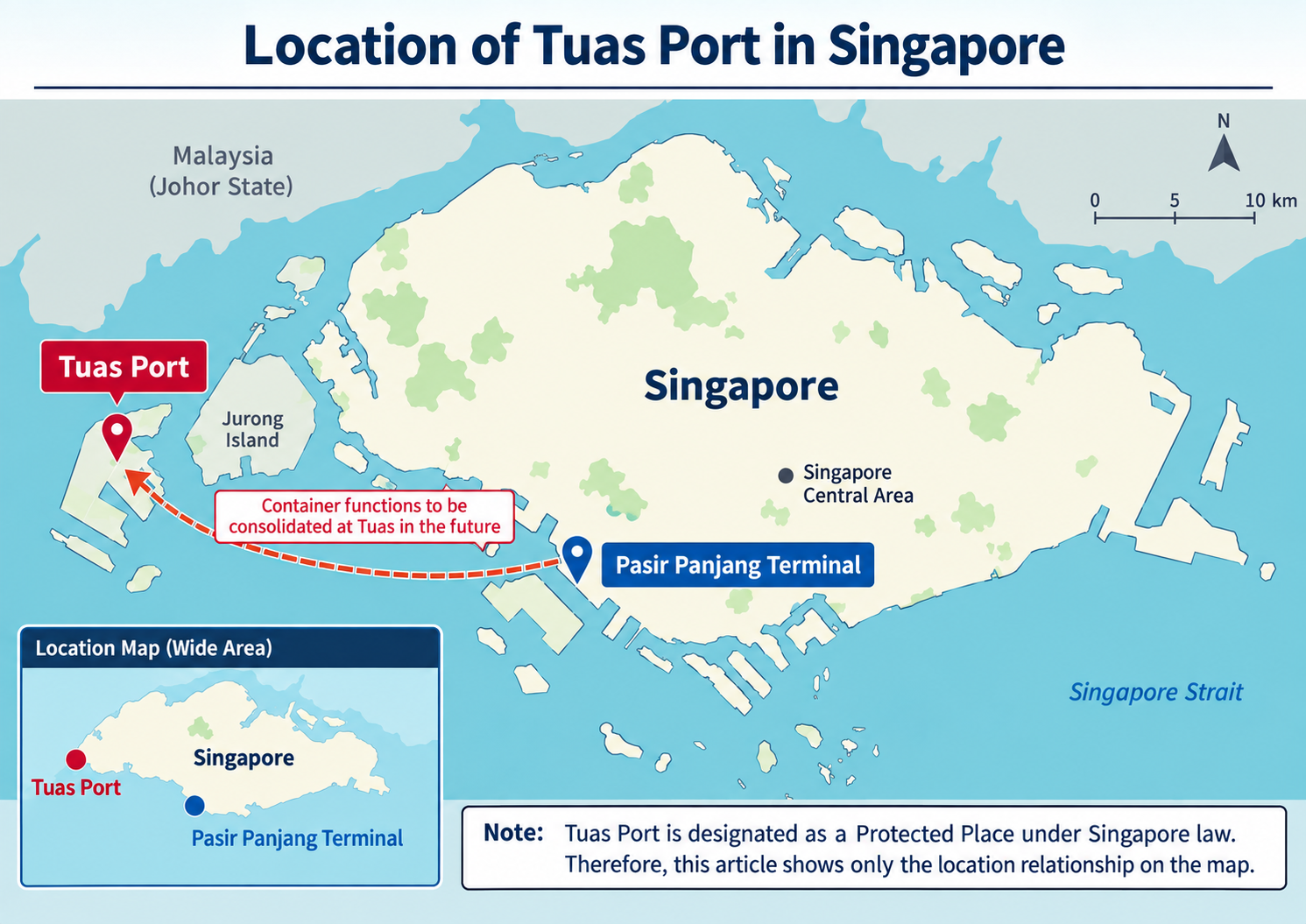
For this reason, Maritime Wiki has not conducted its own on-site photography of Tuas Port. Instead, the geographical relationship between Tuas Port and Pasir Panjang Terminal is shown below using a schematic map based on publicly available information.
Synonyms and Alternative Terms
Port of Singapore, Singapore Port
Related Terms
Pasir Panjang Terminal, Tanjong Pagar Terminal, Keppel Terminal, Brani Terminal, Tuas Port, PSA Singapore, transshipment, feeder transport, Inter-Gateway Transfer, IGT, STS Crane, AGV, B/L, Through B/L, House B/L, Contracting Carrier, Actual Carrier, bunkering, anchorage
Official Information
Maritime and Port Authority of Singapore (MPA), Ministry of Transport Singapore (MOT), PSA Singapore